
The kitchen was usually the loudest room in the house, filled with the aggressive sizzle of garlic in a pan and Maya’s mother, Elena, humming off-key to ninety-six different playlists.
But over the course of three months, the kitchen went dead silent.
It started with a bone-deep fatigue that Elena tried to laugh off as “just getting older.” Then came the erratic joint pain that migrated from her wrists to her ankles like a restless ghost, followed by sudden, terrifying spikes of fever that left her shivering under three layers of wool blankets in the middle of summer.
For fifteen-year-old Maya, the world shifted on its axis.
The Forest of Unanswered Questions
The medical appointments became a blur of sterile waiting rooms and mounting frustration. One specialist blamed a lingering viral infection. Another suggested it was stress and handed over a prescription for vitamins. A third ran a battery of blood tests, only to call a week later with the most frustrating phrase Maya had ever heard: “Everything looks completely normal on paper.”
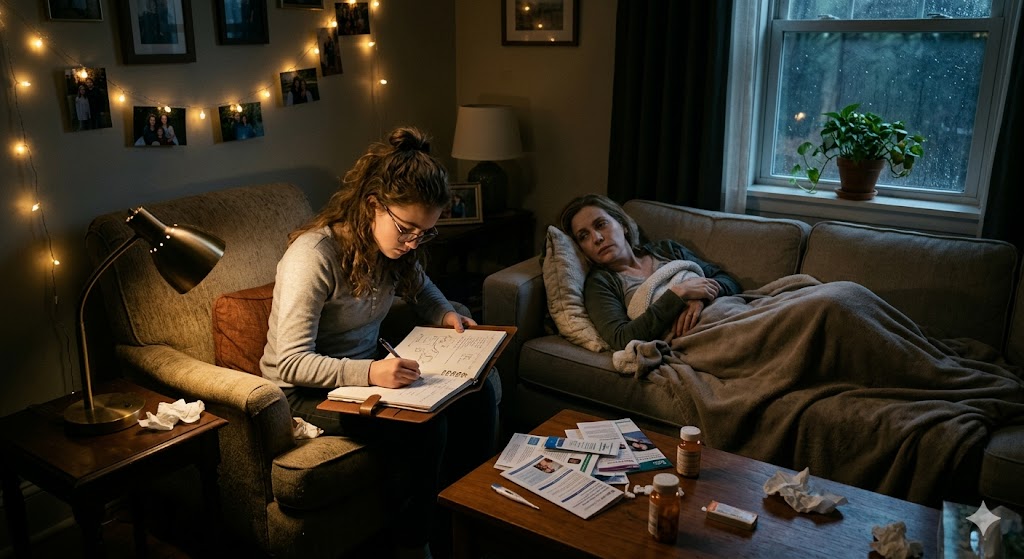
But nothing was normal. Elena’s skin grew pale, her vibrant energy drained away, and she spent her days confined to the couch, looking fragile in a way Maya didn’t know adults could look.
Maya’s mind became an echo chamber of worst-case scenarios. Every night, while her mother slept, Maya sat cross-legged on her bed, illuminated only by the glow of her laptop. She plunged down medical rabbit holes, reading about rare autoimmune conditions, obscure tropical diseases, and neurological anomalies. Her chest felt constantly tight, a heavy anchor of worry dragging her down. What if they never figure it out? What if we run out of time?
One evening, after finding her mother staring blankly at a cold cup of tea, Maya realized something that broke through her panic. While she couldn’t play doctor or decode the medical mysteries, she could control the environment around her mother. The doctors were trying to cure the body, but Elena’s spirit was fighting a losing battle against despair.
Anchoring the Storm
Maya closed her laptop. The frantic late-night searching had to stop. She needed to be an anchor, not a mirror for her mother’s fear.
The next afternoon, Maya began her own version of treatment:
- Mapping the Chaos: Maya bought a thick, leather-bound notebook. She became the ultimate scribe of her mother’s illness. She meticulously tracked Elena’s daily symptoms, food intake, sleep patterns, and temperature fluctuations. If a doctor was going to miss a pattern, Maya wasn’t.
- The Sanctuary Routine: She transformed the living room. She opened the curtains to let the morning sun stream in and kept a rotating playlist of her mom’s favorite upbeat music playing softly in the background.
- Small Victories: On the days Elena couldn’t brush her own hair, Maya would gently brush it and braid it. She made specialized, nutrient-dense smoothies when solid food felt too heavy.
Most importantly, Maya stopped treating her mother like a patient. She brought her school gossip, argued playfully about reality TV shows, and asked for advice on her history projects. She anchored Elena to the normal world, constantly reminding her of who she was outside of her illness.
“You’re carrying a lot for a fifteen-year-old, Maya,” Elena whispered one night, her voice raspy as she squeezed Maya’s hand.
“I’m just keeping the seat warm until you take over again,” Maya smiled, though her throat ached with unshed tears. “We’re a team, Mom. You don’t get to quit on your teammate.”
The Breakthrough
The turning point came on a rainy Tuesday in late autumn. Armed with Maya’s meticulously detailed symptom notebook, they sat across from a new rheumatologist, Dr. Al-Jamil, who had a reputation for solving medical puzzles.
While looking at the standard blood panels, Dr. Al-Jamil looked frustrated. But then, Maya slid her leather notebook across the desk.
“Look at page four,” Maya said, her voice steady. “The joint swelling always peaks exactly thirty-six hours after the low-grade fevers break, and it always coincides with that faint, lace-like rash on her inner wrists. The previous doctors missed the rash because it fades within two hours.”
Dr. Al-Jamil studied Maya’s neat handwriting and the timeline she had drawn. His eyes widened slightly. He looked up, a spark of recognition in his eyes. “You tracked the exact timing of the rash?”
“Every time,” Maya said.
“This isn’t a standard autoimmune profile,” the doctor murmured, leaning forward. “There is a highly specific, rare inflammatory condition called Adult-Onset Still’s Disease. It mimics a dozen other illnesses, and standard blood tests often miss it unless you catch the specific inflammatory markers during a flare-up.”
He ordered a highly specialized, targeted blood panel right then and there.
Three days later, the phone rang. It was the call they had spent months praying for. The tests were positive. They finally had a name for the monster in the room.
The Road Back
Because the diagnosis was so precise, Dr. Al-Jamil was able to start Elena on a fast-acting biological therapy designed specifically to block the erratic proteins causing the inflammation.
The recovery wasn’t instant, but it was spectacular compared to the months of decline. Within forty-eight hours of the first targeted treatment, Elena’s fever broke and didn’t return. Within two weeks, the swelling in her joints subsided enough for her to walk down the driveway to greet Maya coming off the school bus.
A month later, the kitchen was loud again.
Maya walked through the front door to the familiar, glorious scent of garlic and onions sizzling on the stove. Elena was standing at the counter, swaying her hips to a terrible eighties pop song, looking vibrant and alive.
Elena turned, saw her daughter, and opened her arms. Maya buried her face in her mother’s shoulder, finally letting out the last remnants of the heavy worry she had carried for so long.
“The doctors found the right medicine, Maya,” Elena whispered, holding her tight. “But you’re the one who kept me alive long enough to take it.”